Check out our White Paper Series!
A complete library of helpful advice and survival guides for every aspect of system monitoring and control.
1-800-693-0351
Have a specific question? Ask our team of expert engineers and get a specific answer!
Sign up for the next DPS Factory Training!
Whether you're new to our equipment or you've used it for years, DPS factory training is the best way to get more from your monitoring.
Reserve Your Seat Today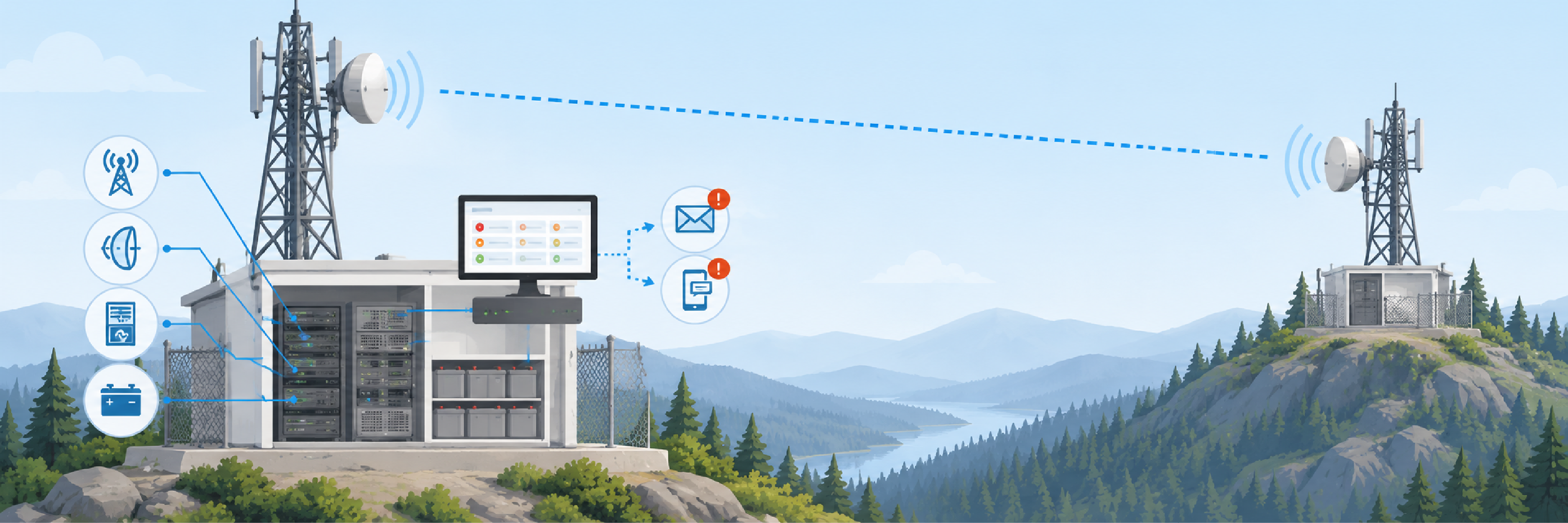
A public safety radio system that cannot reach its vendor's central monitoring environment still needs to be monitored. The radios, the microwave link, the rectifier plant, and the batteries all generate alarms. If nothing collects them, a transmitter failure or a failing battery bank is discovered by the dispatcher who suddenly cannot reach a unit in the field.
This article explains how to build right-sized, standalone monitoring for a small, isolated radio system - two or three sites, a handful of networked devices each - without paying for a platform designed for hundreds of sites. It is written for communications coordinators and radio technicians at fire departments, counties, and small agencies running their own systems.
Large radio networks are usually monitored through the radio vendor's own centralized management environment, which watches radios, repeaters, and site equipment across the whole system. A small system that is physically or administratively isolated from that environment falls outside its reach.
That leaves a gap. The equipment still produces alarms - transmitter failures, power supply faults, temperature excursions, link degradation - but there is nowhere for those alarms to go. Common symptoms of the gap:
The fix is a small monitoring master that collects the network alarms from every device, interprets them correctly, and notifies technicians directly by email and text.
Usually one. When two sites are connected by a microwave link, devices at the far site are reachable over that link from the near site. A single master at one location can poll and receive traps from equipment at both.
Sizing the master to the system is the key cost decision. A system with roughly six networked devices per site - radios, a comparator or simulcast controller, microwave radios, a rectifier controller - is a small deployment. A compact master such as the T/Mon MINI is designed for applications of that scale, while larger masters make sense only when the device count grows substantially.
| System size | Typical approach |
|---|---|
| One site, a few devices | RTU web interface plus email alerts may be enough; no master required. |
| Two to a few sites, networked devices | A compact master collecting SNMP from all devices, with email and text notification. |
| Many sites, mixed protocols | A full-scale alarm master with redundancy and multi-user access. |
Almost every modern radio, microwave, and power device can send SNMP traps. That does not mean a monitoring master will understand them. The meaning of each trap - which variable indicates a transmitter failure, which one is a temperature warning, what severity each deserves - is defined in the manufacturer's MIB.
There are two ways to get from raw traps to meaningful alarms:
The practical step is simple: before buying, send the complete manufacturer and model list for every device to the monitoring vendor and ask which ones are already supported. For anything that is not, ask whether support can be added and what that involves. This one exchange determines most of the integration effort. Understanding how SNMP traps are structured also helps technicians evaluate what each device can report.
Newer lithium battery systems often report detailed status - state of charge, cell condition, temperature, faults - over Modbus rather than SNMP. That data is valuable at remote radio sites because it can replace scheduled inspection visits with condition-based ones.
Two integration paths are common:
For Modbus devices, the key document is the manufacturer's register map rather than a MIB. It defines which register holds which value, and the monitoring platform uses it to read and threshold each one. Modbus integration is routine once that map is in hand, and the resulting values can be reported alongside the SNMP alarms in a single view.
At most radio sites, nearly everything except the rectifiers themselves runs from the -48 VDC battery plant. That is deliberate: the battery plant keeps the site on the air through a commercial power outage.
The monitoring master should follow the same logic. A master powered from commercial AC goes dark at the exact moment a power failure makes monitoring most important. Powering it from the -48 VDC plant keeps it running, reporting, and notifying technicians throughout the outage. DC-powered masters are common in telecom and radio sites for exactly this reason, and it is worth specifying explicitly when requesting pricing.
The same principle extends to the reporting path. If notifications depend on network equipment that loses power first, the master can detect a problem it cannot report. Planning for visibility when the network path is down keeps notifications flowing when they matter.
Many small radio sites already have a basic device collecting hardwired contact closures - door, generator, commercial power - and sending notifications directly to technicians. That arrangement often works well enough to leave in place for the first phase.
Consolidation becomes attractive when technicians want one place to see everything. A small RTU can collect the dry contacts at each site and report them into the same master that collects the SNMP alarms, so contact closures, network alarms, and battery data all appear in one history with one notification scheme.
There is no need to do it all at once. Starting with the networked equipment and adding contact consolidation later keeps the initial project small, which matters when the radio upgrade budget is already stretched.
Monitoring is often the line item added late to a radio system upgrade that has already consumed its budget. A few practices keep it fundable:
Yes, when the sites are connected by a network link such as microwave. The master at one site can poll and receive traps from devices at both.
Raw traps are hard to interpret without the manufacturer's MIB definitions. A master with prebuilt device support turns them into named alarms with appropriate severities, history, and targeted notification.
The complete manufacturer and model list for every networked device at each site, so the vendor can confirm which devices already have prebuilt support.
Poll them directly or through the rectifier or charger controller, using the manufacturer's Modbus register map to define each value and threshold.
So it stays powered from the site battery plant during a commercial power outage, which is when monitoring is most needed.
No. It can stay in place initially, and a small RTU can consolidate those contacts into the same master later.
If your radio system sits outside your vendor's central monitoring environment, a compact, battery-powered monitoring master can collect every network alarm, interpret it correctly, and page your technicians directly. DPS Telecom can review your device list, confirm which equipment is already supported, and size a system to fit a project that is already tight on budget. Get a Free Consultation, or call 1-800-693-0351 or email sales@dpstele.com.

Andrew Erickson
Andrew Erickson is an Application Engineer at DPS Telecom, a manufacturer of semi-custom remote alarm monitoring systems based in Fresno, California. Andrew brings more than 19 years of experience building site monitoring solutions, developing intuitive user interfaces and documentation, and opt...