Check out our White Paper Series!
A complete library of helpful advice and survival guides for every aspect of system monitoring and control.
1-800-693-0351
Have a specific question? Ask our team of expert engineers and get a specific answer!
Sign up for the next DPS Factory Training!
Whether you're new to our equipment or you've used it for years, DPS factory training is the best way to get more from your monitoring.
Reserve Your Seat Today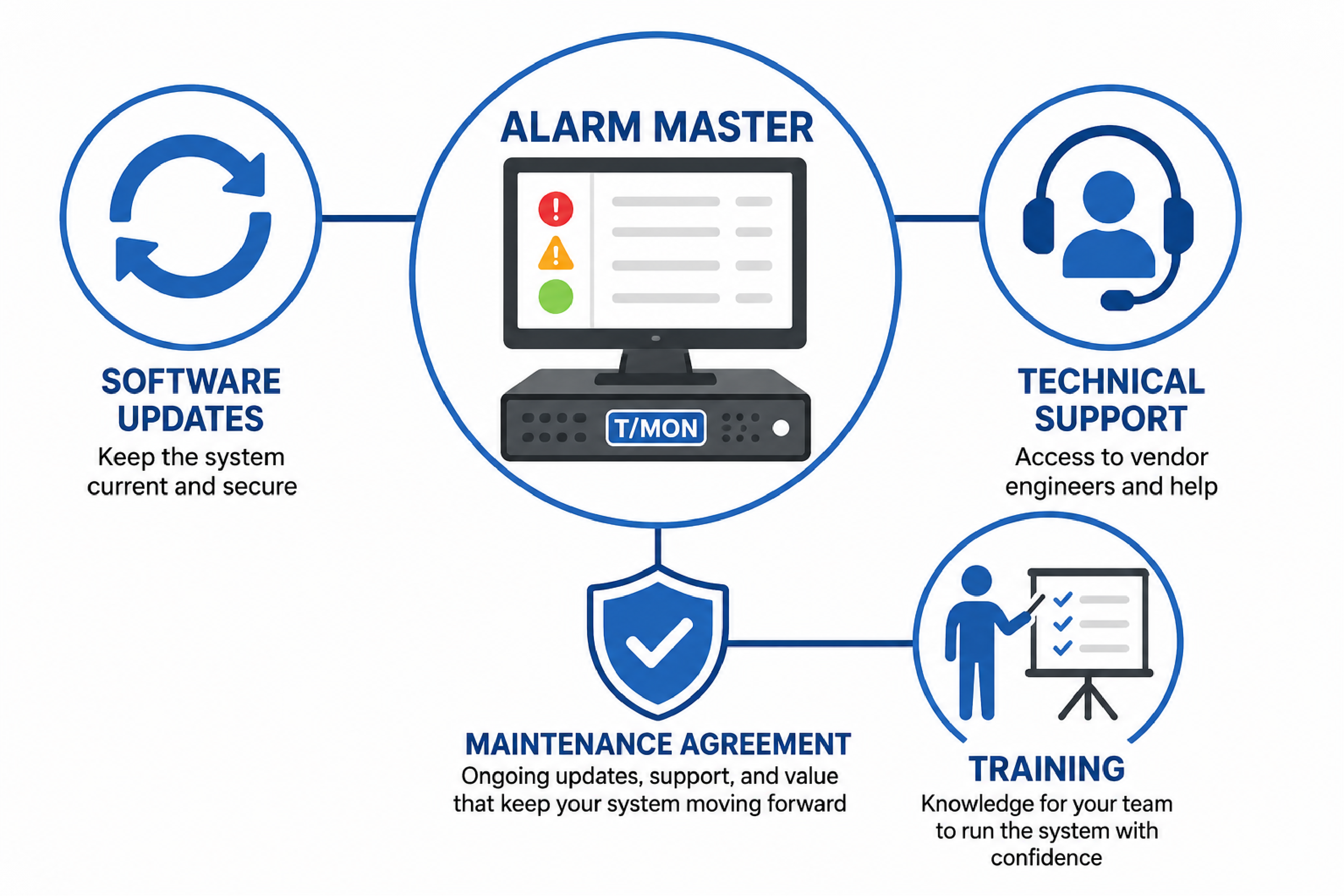
A monitoring platform maintenance agreement is the ongoing support arrangement that keeps a central alarm master current with software updates and backed by vendor support after the initial purchase. For a utility or network operator whose NOC depends on that platform every day, the renewal decision is not paperwork - it is the mechanism that keeps the system supportable for the next several years.
This article explains what a maintenance agreement covers on an alarm master platform, how multi-year renewals compare with annual ones, how to decide when the underlying hardware genuinely needs refreshing, why maintenance records should be reconciled before a renewal is quoted, and how to plan training when a team has grown or turned over. It is written for SCADA, telecom, and operations supervisors responsible for the long-term health of a central monitoring system.
A maintenance agreement (MA) on a central monitoring platform typically covers ongoing software updates and vendor support, keeping the system current as security standards, protocols, and features evolve. It is distinct from the hardware itself: on a platform sold as a one-time purchase, the system continues operating whether or not maintenance is renewed, and the agreement is what keeps it moving forward rather than frozen.
The practical value shows up in three places:
Because the field units keep reporting to the master regardless, the maintenance decision is really about the center of the network: the one system every RTU in the fleet depends on to turn its alarms into action.
A multi-year renewal is a maintenance term purchased for several years at once rather than renewed each year. Vendors commonly discount longer terms, which effectively adds coverage years compared with paying annually for the same span.
The comparison worth putting in front of management:
| Renewal Approach | Advantages | Considerations |
|---|---|---|
| Annual renewal | Smallest single budget line; maximum flexibility year to year. | Highest total cost over the same span; renewal is an annual administrative task that can lapse unnoticed. |
| Multi-year term (for example, 3-year or 5-year) | Discounted against annual pricing - effectively free coverage years; one procurement cycle instead of several; no lapse risk mid-term. | Larger single line item; worth aligning the term with the platform's expected hardware life. |
A practical approach when taking the decision to management is to request both terms quoted separately - a 3-year option and a 5-year option on their own pages - so decision-makers can weigh the budget shapes side by side rather than being handed a single number. The longer the platform's remaining hardware life, the stronger the case for the longer term.
A hardware refresh is the replacement of the platform's underlying appliance, distinct from the software updates maintenance delivers. The most common planning mistake is treating refresh as a fixed-interval event. In practice, refresh timing is driven by specific technical needs, not a calendar.
Legitimate refresh drivers include:
On a current-generation platform, a realistic refresh horizon is measured in many years, often five to ten, and an operator who refreshed recently for a specific technical reason should not expect to do it again soon. If a maintenance agreement includes a discounted trade-up entitlement, that is an option to hold until a genuine driver appears - not an obligation to exercise on a schedule. A vendor being straightforward on this point ("you do not need new hardware right now") is itself a useful signal about the relationship.
Record reconciliation is the step of confirming the true start and expiration dates of the existing agreement before a renewal is quoted. It sounds trivial. It frequently is not.
Dates drift for ordinary procurement reasons: an agreement quoted in one year but not purchased until the next, a term that started when hardware shipped rather than when the quote was issued, or paperwork on the customer side showing different dates than the vendor's system. The result is that the two parties can sincerely believe in expiration dates months or even years apart.
Reconciling before renewal matters for three reasons:
The fix is simple: before quoting, both sides compare records, identify the source of any disjoint, and agree on the anchor date in writing. Five minutes of reconciliation prevents a budget conversation built on the wrong number.
Platform training is the structured transfer of operating knowledge - navigation, alarm handling, configuration, reporting - to the staff who run the system daily. The need typically resurfaces in two situations: new hires join, and the broader team's knowledge has gone stale since the original deployment.
Two delivery models cover most cases:
| Training Model | Best Fit | Notes |
|---|---|---|
| Factory training at the vendor's facility | One or two individuals; new hires who need the full curriculum. | DPS Telecom offers factory training sessions; the per-person model is efficient at small headcounts. |
| On-site training at your facility | A group - several staff plus a broader refresher for the wider team. | One instructor travels instead of many students; content follows the factory curriculum but is tailored to your configuration and workflows; typically several days. |
The crossover point arrives quickly: once more than a couple of people need training, bringing the instructor to the team usually costs less than sending the team to the instructor, and everyone trains on the organization's own system rather than a generic one.
Scheduling deserves the same planning as content. Choose a window that avoids the operation's heavy season and its weather risks, and give the vendor enough notice - a month or more - to quote travel accurately. Right-sizing the agenda matters too: a session tailored to what the team actually needs can often be a day shorter than a maximal one, which trims cost without trimming value.
Lifecycle planning is the practice of treating maintenance renewal, hardware refresh, and staff training as one coordinated program rather than three disconnected purchases. Looked at together, a sensible pattern emerges:
Bundling the decisions has a practical benefit: a single proposal covering the renewal options and a training visit gives management one coherent picture of what keeping the platform healthy costs, instead of three surprise line items across the year.
On a one-time-purchase platform, no - the system keeps operating. What stops is forward motion: software updates, security fixes, and vendor support access. A lapse converts a maintained platform into a frozen one, which matters most the day a security scan flags something or a problem needs vendor engineering.
Usually, when the platform has years of hardware life ahead. Multi-year terms are discounted against annual pricing - effectively adding coverage years - and remove the annual lapse risk. Quoting the 3-year and 5-year options separately lets management compare the budget shapes directly.
Far less often than annual budgeting instincts suggest. On a current-generation platform with solid-state storage, a five-to-ten-year horizon is realistic. Refreshes should be driven by specific needs - OS capability, security standards, end of support - not by a fixed interval.
Neither, until reconciled. Quote and purchase dates commonly drift apart, so both sides should compare records, find the source of the disjoint, and agree on the anchor date in writing before any renewal is quoted against it.
As soon as a group needs it. Sending one or two people to factory training is efficient; once several staff plus a broader refresher are involved, bringing one instructor on-site typically costs less than sending everyone out, and the team trains on its own system.
Plan for at least a month, and pick the window deliberately - after the operation's busy season and outside its weather-risk months - so the visit lands when the team can actually absorb it.
If your central monitoring platform's maintenance is coming due, the renewal is the natural moment to look at the whole lifecycle: verify the true expiration date, weigh a multi-year term against annual renewal, confirm whether the hardware actually needs anything yet, and get the team trained while the budget conversation is already open. DPS Telecom can prepare renewal options side by side, give you a straight answer on refresh timing, and quote an on-site training visit sized to your team. Get a Free Consultation, or call 1-800-693-0351 or email sales@dpstele.com to plan your platform's next several years.

Andrew Erickson
Andrew Erickson is an Application Engineer at DPS Telecom, a manufacturer of semi-custom remote alarm monitoring systems based in Fresno, California. Andrew brings more than 19 years of experience building site monitoring solutions, developing intuitive user interfaces and documentation, and opt...