Check out our White Paper Series!
A complete library of helpful advice and survival guides for every aspect of system monitoring and control.
1-800-693-0351
Have a specific question? Ask our team of expert engineers and get a specific answer!
Sign up for the next DPS Factory Training!
Whether you're new to our equipment or you've used it for years, DPS factory training is the best way to get more from your monitoring.
Reserve Your Seat Today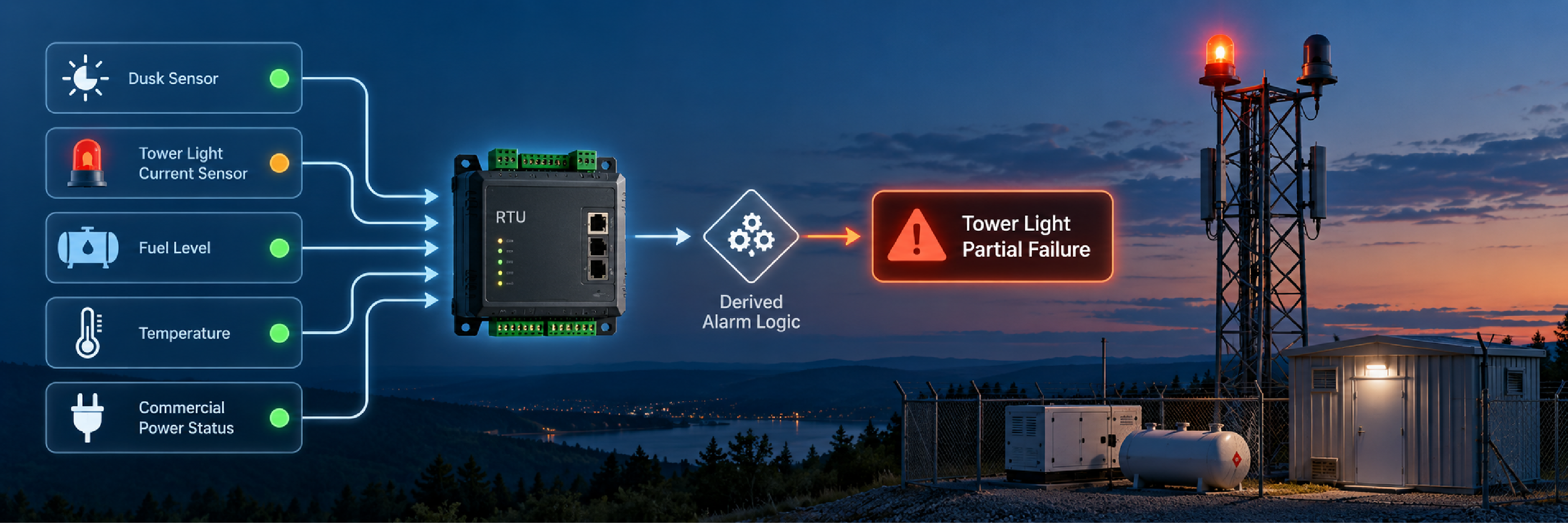
A contact closure tells you one fact. A tower light current sensor says the beacons are drawing 1 amp. A dusk sensor says it is dark. Neither alarm, on its own, says what a technician actually needs to know: one of two bulbs has burned out and someone should go replace it before the other one fails.
Derived alarm logic is the practice of combining several raw inputs inside the remote telemetry unit (RTU) to produce a more meaningful alarm than any single input can. This article explains how derived alarms, runtime accumulators, and analog fuel and environmental sensing turn a stream of raw points into decisions - and why they reduce nuisance alarms and truck rolls. It is written for utility and telecom teams who already monitor their sites and want more value from the points they collect.
A derived alarm - sometimes called a virtual alarm or virtual relay - is an alarm point that does not correspond to a physical input. Instead, it evaluates a Boolean expression across several real inputs and triggers when the combination is true. It can then raise its own alarm, escalate severity, or operate a control relay.
The tower light example shows why this matters. With a dusk sensor on a contact closure and a current sensor on the beacon circuit:
| Dusk sensor | Beacon current | Meaning | Response |
|---|---|---|---|
| Dark | About 2 A | Both bulbs lit | Normal |
| Dark | About 1 A | One bulb burned out | Schedule a repair |
| Dark | 0 A | Tower lights out | Urgent, possible regulatory issue |
| Daylight | 0 A | Lights correctly off | Normal |
Without derived logic, the current sensor alone would alarm every morning when the lights correctly shut off, and staff would learn to ignore it. With derived logic, each state produces the right message at the right severity. That is the practical value: fewer nuisance alarms, and more credible real ones.
Many conditions are routine on their own and serious in combination. Derived logic lets the RTU recognize the combination and escalate before a person has to connect the dots.
Because the logic runs in the RTU, the escalated alarm is sent upstream like any other point - as SNMP traps to a manager, by email, or to a central alarm master - with no special handling required at the head end.
A runtime accumulator is a counter that adds up the time an input spends in a given state and alarms when the total crosses a threshold. It turns a status point into a maintenance and compliance tool.
Common uses:
That third pattern is worth highlighting because it answers a compliance question automatically, from points most sites already monitor, without anyone keeping a spreadsheet.
Remote fuel level monitoring reports how full a generator's fuel tank is, so refueling can be scheduled before a long outage rather than discovered during one.
On propane tanks, the most common approach uses a remote-ready float gauge. A magnetic dial on the tank is read by a sensing cap that converts the dial position into an electrical signal the RTU can measure. Several practical points make this attractive:
A note on sizing: gauge dial size does not necessarily correspond to tank size, so confirm the gauge model on the tank rather than inferring it from tank capacity.
Newer generators are also moving away from contact closures entirely. Many now report run status, fault codes, and fuel data over Modbus. An RTU that can poll Modbus devices - over TCP on the network or RTU over RS-485 - can still deliver the familiar generator run and fail-to-start alarms, just sourced differently, and then report them northbound over SNMP. The same applies to HVAC controllers and newer battery systems that expose status over Modbus.
A temperature contact tells you a threshold was crossed. An analog temperature sensor tells you the actual value - 70, 80, or 50 degrees - and supports four thresholds: minor over, major over, minor under, and major under. That value is what lets a technician decide whether a truck roll is actually needed.
Distributed D-Wire sensors make this easy to deploy:
Analog readings also feed derived logic. A temperature value combined with HVAC status is far more informative than either alone.
Derived alarms, accumulators, and expanded protocol support generally arrive with newer RTU generations, which have the processing headroom and memory for more logic and stronger encryption. The practical question for a utility with a large installed base is how disruptive the upgrade is.
Two points reduce the friction considerably:
That makes the newer generation a planned option rather than an emergency project. DPS Telecom documents its monitoring security approach for teams evaluating those requirements, and choosing the right RTU for each site type keeps the fleet consistent as it evolves.
A virtual relay is a logic point that evaluates several real inputs with a Boolean expression and then raises an alarm, changes severity, or operates a control relay when the combination is true.
By alarming on meaningful combinations rather than raw states. A beacon current of zero is normal in daylight and serious at night; a derived alarm knows the difference.
Yes. A runtime accumulator totals generator run time. A second accumulator on commercial power loss lets you subtract outage hours and report exercise time separately.
Typically not. Remote-ready gauges generally replace the existing gauge with a couple of screws, and the sensing cap snaps onto the dial.
An RTU that polls Modbus can read run status and faults directly from the generator controller and still report the familiar alarms northbound over SNMP.
It need not be. Where connector pinouts are unchanged, a swap means moving the existing cables to the new unit without re-terminating anything.
If your sites already report dozens of raw points and your staff still has to interpret them by hand, derived alarms, runtime accumulators, and analog fuel and environmental sensing can put that interpretation into the RTU itself. DPS Telecom can review the points you already collect and show which combinations would cut nuisance alarms and truck rolls on your network. Get a Free Consultation, or call 1-800-693-0351 or email sales@dpstele.com.

Andrew Erickson
Andrew Erickson is an Application Engineer at DPS Telecom, a manufacturer of semi-custom remote alarm monitoring systems based in Fresno, California. Andrew brings more than 19 years of experience building site monitoring solutions, developing intuitive user interfaces and documentation, and opt...