Check out our White Paper Series!
A complete library of helpful advice and survival guides for every aspect of system monitoring and control.
1-800-693-0351
Have a specific question? Ask our team of expert engineers and get a specific answer!
Sign up for the next DPS Factory Training!
Whether you're new to our equipment or you've used it for years, DPS factory training is the best way to get more from your monitoring.
Reserve Your Seat TodayCC Communications, a telecommunications provider serving Churchill County, Nevada, needed clearer network visibility and faster alarm notification. By deploying a DPS Telecom T/Mon NOC system with 24/7 pager notifications, the team improved awareness of issues and supported higher uptime.
| Industry | Telecommunications |
|---|---|
| Company | CC Communications |
| Geography / Coverage | Churchill County, Nevada; remote sites across Nevada |
| Primary Challenge | Limited network visibility and delayed awareness of outages without centralized monitoring and automated notifications |
| Solution Deployed | T/Mon NOC alarm monitoring system configured for 24/7 text pager notifications |
| Key Result | Faster awareness of problems (including critical events like fiber failure), improved troubleshooting, and better overall uptime |
| Products Used | T/Mon NOC |
CC Communications is deeply rooted in the history of Churchill County, Nevada. Since 1889, they have served Churchill County - first as the local telegraph company, then as the local telephone company, and today as a full-service, state-of-the-art telecommunications provider.
As their network evolved, CC Communications recognized the operational value of centralized alarm visibility and consistent notification when conditions change across remote sites.
"I really believe in the DPS program: the way you guys take care of your clients and the way your units take care of our networks..."
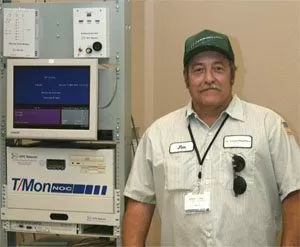
CC Communications has used DPS Telecom monitoring equipment since they first recognized their need for network visibility. Toll Technician James Granger has found consistent, positive results with the service at DPS.
Speaking during a DPS Factory Training Event, Granger described why dependable monitoring and responsive support matter in daily operations:
"I really believe in the DPS program: the way you guys take care of your clients and the way your units take care of our networks," Granger said. As the primary operator of their T/Mon NOC, which gathers information from remote sites across Nevada, Granger sought better alarm notifications to increase CC's overall uptime.
"Every time I come to DPS, I always leave with something new..."
Prior to deploying the T/Mon, CC Communications did not have a network monitoring system. Although CC had a relatively small number of sites to monitor, inadequate network visibility was still damaging.
Without automated text pages sent from T/Mon, CC Communications' customers were sometimes their first notification of a problem.
"Before we got the T/Mon, things were just a mystery, and the customers were telling us what wasn't working," Granger said.
CC Communications addressed the visibility gap by deploying a DPS Telecom T/Mon NOC system and configuring it to send text pages to the team when alarms occur.
At a high level, the T/Mon approach is to centralize alarm collection, correlation, and notification so operators can respond quickly. Depending on the environment, T/Mon systems can consolidate alarms from telemetry devices, network elements, and other monitoring sources and then route notifications to the right people using paging, email, and other workflows. In CC Communications' deployment, their T/Mon NOC gathers information from remote sites across Nevada and provides rapid alarm notification to support uptime.
After installing a DPS T/Mon NOC system, CC Communications knows instantly when a problem occurs. T/Mon has consistently alerted Granger of problems within the network, including a fiber failure that severed their connection with nearby Reno.
With pager notifications enabled, the team no longer has to wait for customer reports to learn about service-impacting issues. T/Mon pages allow technicians to react quickly and begin triage as soon as an alarm is received.
T/Mon also allows Granger to troubleshoot network issues by building a history of events and repeat errors.
"We're able to start monitoring and making a history of repeat errors, and we can self-diagnose before we even roll the truck on it," he said.
After participating in his second Factory Training Event at DPS Headquarters, Granger learned techniques for operating his T/Mon system more effectively.
"Every time I come to DPS, I always leave with something new," Granger said.
Though he had all the pieces to his network puzzle, Factory Training helped him discover benefits he did not realize were available in his updated system.
"Coming back to DPS, we went through all the new features," said Granger. "Even though I had done the latest software update, I was unaware of what the new features could do for me. Coming to training was a big help."
"I call DPS and, within minutes, somebody is working on my problem..."
In addition to regular system enhancements, Granger highlighted the responsiveness of DPS Telecom technical support over the years.
"The T/Mon itself is an excellent unit," he said. "If there are any problems, I call DPS, and within minutes somebody is working on my problem. The support from DPS is just awesome."
If you are building or modernizing a telecom NOC, DPS Telecom recommends using T/Mon alarm monitoring to centralize alarms and drive fast, consistent notifications to on-call staff. For teams that also need to bring in discrete alarms, analog telemetry, and SNMP-based network alerts, DPS Telecom can help design an end-to-end monitoring architecture that fits the site count, escalation needs, and operational workflow.
T/Mon NOC centralizes alarm information from monitored sites and presents it to operators in a way that supports fast recognition, triage, and notification. In this story, it gathers information from remote sites across Nevada and pages technicians when alarms occur.
Even with a modest number of sites, outages can be hard to detect without monitoring. Automated paging helps ensure the operations team learns about faults immediately rather than hearing about them from customers.
By retaining a record of alarms and repeat errors, operators can identify patterns, confirm recurrence, and begin diagnosis sooner. As described by the operator in this story, this supports self-diagnosis before dispatching a truck.
Factory Training helps operators understand new features and practical operating techniques, especially after software updates, so the system is used to its full capability.
Focus on notification speed, clarity of alarms, ease of troubleshooting, and vendor support responsiveness. DPS Telecom designs monitoring solutions with these operational requirements in mind.
To discuss pricing, configuration, or an ROI analysis for a DPS Telecom monitoring solution, call 1-800-693-0351.
Get a Free Consultation to review your alarm visibility requirements and design the right T/Mon-based notification workflow for your network.