Download our free SCADA tutorial.
An introduction to SCADA from your own perspective.
1-800-693-0351
Have a specific question? Ask our team of expert engineers and get a specific answer!
Sign up for the next DPS Factory Training!
Whether you're new to our equipment or you've used it for years, DPS factory training is the best way to get more from your monitoring.
Reserve Your Seat Today
Responsible for providing clean, safe water to his Sonoma, Calif. community, Chris LaVay wanted a better SCADA alarming approach for the De Anza Moon Valley water treatment plant. After evaluating options and attending training at DPS Telecom Headquarters, he began planning an alarm retrofit centered on analog sensors, control relays, and NetGuardian remote alarm notifications to reduce manual checks and improve after-hours response.
| Industry | Water treatment |
|---|---|
| Company / Site | De Anza Moon Valley water treatment plant |
| Role Interviewed | Chris LaVay, Facility Manager |
| Geography / Coverage | Sonoma, Calif. community |
| Primary Challenge | Time-consuming manual monitoring of mostly analog sensor data and delayed response to night-time water events (for example, high flow rates indicating a potential massive leak) |
| Solution Deployed | Alarm retrofit planning based on additional analog sensing, alarm contacts, control relays, and pager/email notifications using NetGuardian remotes; exploration of electric valve isolation for leak containment |
| Key Result | Improved plan for faster alarm notification and leak isolation, with the goal of reducing manual rounds and limiting damage from after-hours events |
| Products Used | NetGuardian remote alarm monitoring (planned) |
De Anza Moon Valley is a water treatment operation serving a local community in Sonoma, Calif. LaVay oversees equipment and water quality processes tied to safe drinking water, including disinfection activities performed under Department of Health Services regulations.
The plant is on a well system, which LaVay described as a 600-foot deep well. Much of his day-to-day operational visibility depends on analog measurements and physical checks at the equipment.
LaVay reported spending significant time physically monitoring the water-treatment equipment and interpreting analog sensor data. In addition to the time requirement, his concern was that some events can occur at night, when the facility is not being actively observed.
"We do have an existing alarm system, but frankly, it doesn't hold a candle to DPS equipment. I mean, it's not even close..."
One example he cited was high flow rates outside parameters he has set. In his experience, those conditions can indicate a major leak, but if it is not detected and acted on quickly, the outcome may be a late phone call after damage has already occurred.
Constant Equipment Monitoring Kept Him From Other Job Responsibilities...
LaVay explained that maintaining safe drinking water requires collecting and reviewing a large amount of sensor information during disinfection activities. He described routinely gathering outputs such as velocities, flow rates, injection rates, dosages, and chlorine residuals, which can pull him away from other priorities.
After evaluating how DPS Telecom approaches alarm monitoring, LaVay began planning a retrofit of the existing alarm system to better align with the plant's analog-heavy monitoring needs. His proposal centered on adding sensors and integrating those measurements into alarm notifications that would reach him immediately.
"I get paged and BOOM - I go out there and take care of it..."
LaVay specifically discussed strengthening alarming with analogs and control relays. In practical terms, that means using analog sensors in the right locations, setting thresholds and parameters, and generating alarms when readings deviate from safe ranges. In a water treatment environment, this can include monitoring values like chlorine residuals and flow rates so an operator can respond before a situation escalates.
For remote notification, LaVay planned to use pager and email notifications available with NetGuardian remotes. This approach is consistent with how DPS Telecom RTU-based alarming is commonly used in utility operations: the RTU collects analog values and discrete alarm contacts, applies threshold logic, and sends notifications so personnel can respond without waiting for a manual check or a secondary escalation path.
At a training event at DPS Telecom Headquarters, LaVay focused on learning more about SCADA implementation and the DPS devices that could provide improved alarm notification. With that training completed, he reported that he was working on a proposal to revamp alarm monitoring at De Anza Moon Valley.
His planning included multiple layers of field visibility and control:
He also described using electric valve isolation as part of a containment strategy. In his concept, if high flow rates are detected in a particular area, isolation valves could be shut to contain and limit a leak while he travels to the site.
Because LaVay was developing a proposal for the retrofit, the primary outcome at the time of this story was a clearer plan for improving alarm visibility and response. His goal was to reduce the amount of time required for manual monitoring and to receive actionable alarms quickly when readings fall outside defined parameters.
LaVay summarized the value of upgrading the alarming and response approach:
"It could save us millions of dollars..."
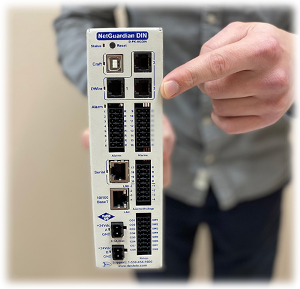
NetGuardian RTU family - Remote alarm monitoring for analog and discrete inputs with notification capabilities (planned for the De Anza Moon Valley retrofit).
For water and wastewater monitoring scenarios, DPS Telecom systems are commonly used to bring critical analog readings and alarm contacts into a single notification and escalation path, reducing dependence on manual rounds and improving after-hours awareness.
An alarm retrofit typically means improving how existing field signals (analog measurements and discrete contacts) are collected, alarmed, and notified - without replacing the entire process control system.
Many critical process conditions are measured as analog values (such as flow rates and chemical residuals). Threshold alarms on analog points can notify operators before conditions become violations or damage occurs.
NetGuardian RTUs are designed to collect field inputs and send notifications (such as pager and email alerts) when conditions exceed defined parameters, helping operators respond quickly when no one is on-site.
Valve isolation is an operational approach where isolation valves are shut to contain a leak to a smaller area. When paired with reliable alarming on high flow rates, it can help limit damage while personnel travel to the site.
Not necessarily. Many plants use DPS Telecom alarming as a practical complement to SCADA, especially when the goal is dependable alarm notification and clear escalation based on real field measurements.
If you are planning a SCADA alarm retrofit for water treatment - especially one that depends on analog sensors, discrete contacts, and clear after-hours notifications - DPS Telecom can help you map signals, thresholds, and escalation to a practical RTU-based design.
Get a Free Consultation or call 1-800-693-0351 to speak with a DPS Telecom expert about your project.