Download our free SCADA tutorial.
An introduction to SCADA from your own perspective.
1-800-693-0351
Have a specific question? Ask our team of expert engineers and get a specific answer!
Sign up for the next DPS Factory Training!
Whether you're new to our equipment or you've used it for years, DPS factory training is the best way to get more from your monitoring.
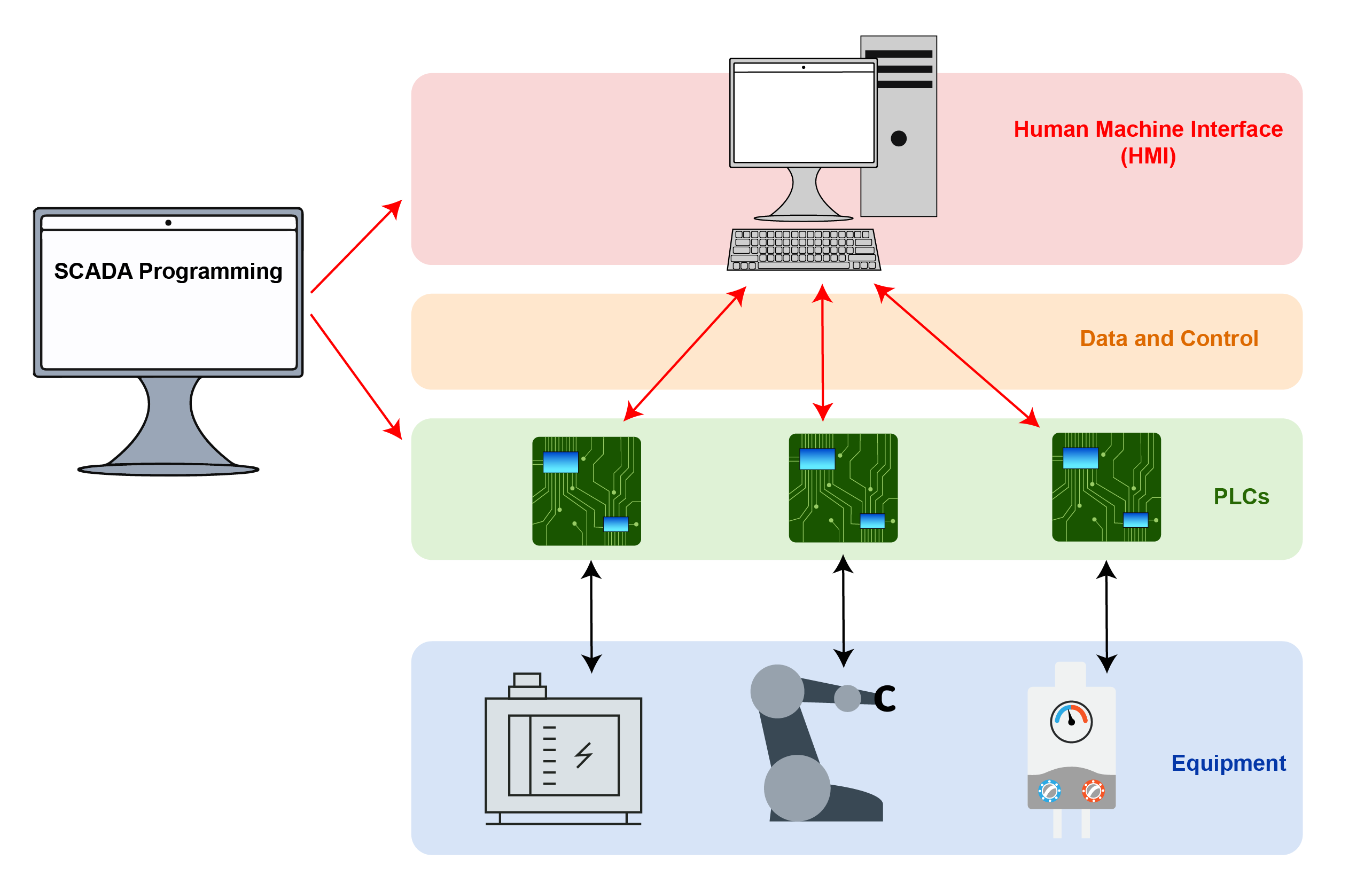
Reserve Your Seat TodayA Programmable Logic Controller (PLC) is one of several field device types that are deployed at individual remote locations. They process data while providing control access over industrial processes from a central SCADA console (SCADA stands for supervisory control and data acquisition) - also called Human-Machine Interface (HMI). If the central SCADA console can be described as the brain of your SCADA software system, then the PLCs are the nerves and muscles. They send information in real-time to the brain and act on its commands.
In the manufacturing industry, SCADA PLC systems can usually be found next to each of the various manufacturing machines that must be monitored and controlled. Other PLCs might monitor in-process inventory as it moves through machines. Imagine a PLC with a temperature sensor that monitors the temperature of a key ingredient at a food manufacturing facility.
In water processing, each PLC is used by the SCADA computer system to monitor and/or control one aspect of the process. Each PLC might be used to monitor:
Water quality for contaminants
Flow rates at key areas in the water processing facility
Or remotely control valves that control in-process water flow.
PLC monitors are typically quite customizable, but this can be a double-edged sword. Some competing technologies, including most notably SCADA Remote Terminal Units (RTUs) (including Intelligent Electronic Devices or IEDs), require significantly less labor time and expense to set up and use.
An RTU, compared to a SCADA PLC, is generally more rugged and has higher monitoring and control capacities than a PLC. This makes SCADA RTUs superior at locations where many items must be monitored and controlled. If you have more locations that require just a few monitor/control nodes, then PLCs will probably be best for you.
As we've said previously, PLC stands for Programmable Logic Controller and because of this high customization feature, they are commonly found in manufacturing and processing settings. Because plant operations can vary so widely, the customization of PLCs is a useful tool. Nonetheless, RTUs have their place protecting industrial automation processes and the IT assets of a facility.
In the server room of a manufacturing facility, for example, the monitoring and control needs are exactly the same as those in the server room of a major office building. RTUs are better suited for this sort of environment.
Although PLC customization offers advantages for veteran users, others may prefer to order an RTU custom-designed for their monitoring and control situation. The real trick here is identifying a manufacturer with the necessary facilities and experience to help you.
Look for a company that has engineering and manufacturing inside of its organization (DPS engineers and manufactures ALL of its units). The last thing you want to do in the deployment of your important SCADA system is to wait for overseas development and manufacturing to be delivered. This is where quality also becomes a concern.
So long as you watch for this potential pitfall, you can have good luck requesting a custom-designed RTU for your SCADA system. If you do your homework, this will be no more expensive than ordering off-the-shelf. As long as you're ordering a reasonable quantity (at least 10 or so), it's generally worthwhile for a manufacturer to develop a solution for you.
Wait time will generally be fairly short (about 1-2 months from a vendor that has its own engineering and manufacturing). Remember that, while your custom SCADA RTU may have unique capacities, there probably isn't anything earth-shattering about its functionality. It shouldn't require nearly the development time that a completely new product would require.
DPS has worked on several projects that included SCADA PLC remote monitoring and control. Here are a few such examples:
One client contacted DPS asking for a way to have PLC alarm trigger a phone call. "I'm working on a cold storage facility. They already have temperature switches installed in the field connected with PLC. In case of any deviation in temperature the PLC receives the signal and alarm is generated."
The solution here was to notify technicians about alarms via a phone call. Once there was an alarm, the PLC would energize a relay. The potential free contact would activate an alarm dialer (NetGuardian LT) that would issue calls to the predefined telephone and play a pre-recorded message.
Another client called in after finding DPS via web search. They are a food processing plant with several industrial machines with PLC's. He wanted to be able to bring that data over his network via a DB9 port. He did not know if it was an RS232 or RS485 signal.
At the time, he connected to the PLC via his laptop's DB9 port. But he can only connect one at a time and he has to take the laptop with him to each station. He wanted to be able to bring that connection onto his network and use his PC to accept/report back to the industrial machine(s).
This way, it eliminates him from having to go to each station to get data. The right solution here was the NetGuardian 832A G5 with its 8 terminal server serial ports.
One modern RTU designed with SCADA in mind is the NetGuardian 480. This model includes, most importantly, a choice to use the DNP3 protocol for alarm reporting and control commands. The other option, SNMP, is used more commonly in telecom and IT environments.
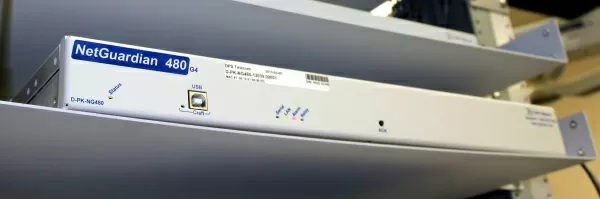
The capacities of the NetGuardian 480 were designed to accommodate the larger number of sensors generally need in SCADA environments. This NetGuardian supports up to 16 analog sensors. This allows users to monitor temperature, humidity, flow rate, and other analog sensors in two different output formats. And you can access all this information from an intuitive graphical user interface.
The NetGuardian 480 also includes 80 discrete inputs and 4 control relays for controlling external equipment. This allows for the monitoring of discrete "on/off" type events.
The NetGuardian 480 RTU can perform functions very similar to a SCADA PLC, but it does not require nearly the development or scripting expertise to develop a working PLC system.
Larger RTU models have also been made available by the manufacturer: DPS. These are useful if you have particularly high-density areas that must be handled by your SCADA system. In these areas, SCADA PLCs truly become inefficient.
Also, keep in mind that DPS is a vertically integrated company. With engineering and manufacturing under the same roof as sales, DPS doesn't force you to call a know-nothing call center to place your order. If you have a specific need for a SCADA PLC or RTU, you'll be connected with experts. They have worked with all sorts of monitoring and control systems and who can handle even unusual SCADA requests.
All DPS Telecom products include comprehensive technical support. If you've purchased one of our products and are encountering any kind of issue, contact DPS Tech Support today at 559-454-1600.
At DPS Telecom, the representative who answers your call isn't an intern reading from a script. DPS Tech Support representatives are engineers who contribute to product development. And, if your problem requires additional expertise, the DPS Engineering Department that designed your product is right down the hall.
Help us connect you to the right engineer by filling out this quick questionnaire. Simply leave your contact information to get started, and we'll call you back. Most preliminary discussions are about 15 minutes, and afterward, we'll send you a custom application diagram of a recommended solution that'll make it easier to justify your project to management.