Download our free Monitoring Fundamentals Tutorial.
An introduction to Monitoring Fundamentals strictly from the perspective of telecom network alarm management.
1-800-693-0351
Have a specific question? Ask our team of expert engineers and get a specific answer!
Sign up for the next DPS Factory Training!
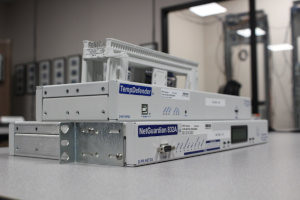
Whether you're new to our equipment or you've used it for years, DPS factory training is the best way to get more from your monitoring.
Reserve Your Seat TodayHave you recently become involved in a remote monitoring and control effort? Has your company realized how vital remote monitoring of revenue-generating gear is? This vital function was followed in traditional enterprises like Telecom, utility, and railway companies. With the push toward leaner operational models, it has received somewhat less attention.
A well-run telemetry system can provide a stable network that exceeds customer needs. A very small margin of competitive advantage in reliability can result in dramatic gains in market share.
During periods of rapid network growth, remote monitoring and control can frequently be under-valued. Mainly because newer gear most likely has fewer operation 'glitches' or interruptions of service. However, doing so increases a company's risk of losing customers and seeing declines in revenue.
In the modern marketplace, customers have gotten used to high levels of product and service quality. People are not as amazed by 'new' tech and honey-moon periods are much shorter than they used to be. Users are less tolerant of service stops or even minor product failures. Customers are more willing to switch to competing product and service providers when their perception of their current provider declines.
A quality remote monitoring and control system results in improved system reliability that translates very directly to increased customer satisfaction.
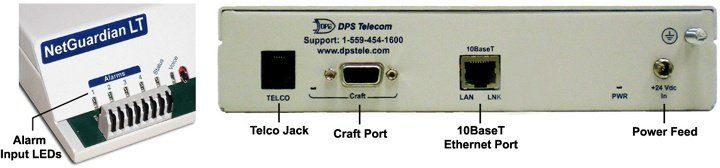
Modern remote monitoring and control units will typically provide a lot of facility plus the traditional alarm collection capabilities. Serial ports can provide remote 'craft' access to gear that would otherwise require a site visit.
In addition to the IP, remote monitoring and control units accommodate a range of transport options for the collected telemetry. Traditional, communication media includes analog '202', digital '422/485' and common '232' channels. Some RTUs support outbound and/or inbound dial-up for cases where plain old telephone service (POTS) is the only practical access.
Remote monitoring and control involve telemetry. This means technologies that allow for the collection and reporting of info from usually geo diverse locations to a central network management location. This provides visibility of network health or status. It also allows for the quick maintenance and repair.
Remote monitoring and control software should not be limited to a small number of remotes. Today, single monitoring solutions for single gear frequently results in confusion when training staff and managing alarms.
Remote monitoring and control software should also be designed around a proven model. Consumer-grade software often reflects a casual approach more typical in IT cases. Gear monitoring requires a better design.
Poor software design choices can result in any number of challenges in deploying a quality remote monitoring and control system. Some popular IP based solutions have chosen UDP for delivering events but are not secure. When the visibility of your network status is most important, non-guaranteed delivery options are a poor choice for vital events.
A quality remote monitoring and control system requires design resources. A high-quality product for your application is also a must. Generic, off-the-shelf solutions can seem good in terms of the purchase price. Using these may involve big backup costs that are more than the sometimes higher start-up cost of a custom solution.
DPS Telecom T/Mon software is built on a client-driven design that keeps true operational status even as events are processed. An event can occur that places a device in your network in degraded operational status. you will retain visibility to the degraded device status until it is restored. Clearing the event, while a vital management processing step, does not cause a T/Mon master to display an all-clear status.
T/Mon software is deployed on server-class platforms. T/Mon masters are not simply off-the-shelf workstations. The enclosure and power options are custom designed and manufactured for industrial strength.
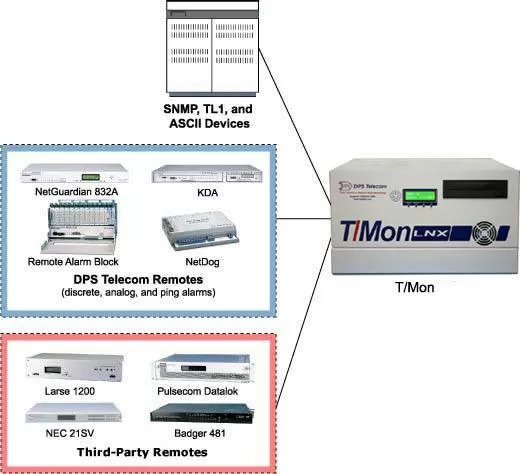
T/Mon master software is able to integrate a lot of older remote monitoring and control units and reporting protocols. It also supports a lot of media interface options for connecting to systems that cannot be upgraded or replaced with a 'newer' transport facility without spending a lot. You may have an installed base of remotes that report telemetry over carefully tuned analog 202 channels. TMon can connect to the head-end without expensive external interface converters.
The DPS sales team works closely with DPS design engineers to ensure that your needs are clear. Many factors are considered in making a proposed solution that fits your needs. Often, the design team can see issues that have not been seen in environments where telemetry staff is trying to keep up with expectations.
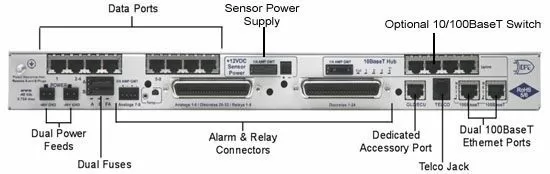
This flexibility is made possible because DPS Telecom solutions involve a readily adaptable software component. This allows the DPS design team to quickly adapt an existing hardware platform to accommodate your application.
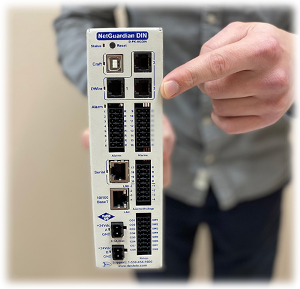
Commercial quality remote monitoring and control solutions like the DPS Telecom NetGuardians are designed for industrial use. Even while maintaining the features that are found in the lighter-duty, consumer grade solutions. DPS RTUs have 120/240VAC options but also offer 24/48VDC support for cases that implement these power options.
The NetGuardians vary in capacity from the 16 point NetGuardian 216 to the 64 point NetGuardian 864. Due to the flexible software, the NetGuardian can be 'stacked' to provide up to 256 points from a single responder.
NetGuardian remotes are able to manage both serial and parallel alarm input. They can also be ordered with a variety of configurations including TTL and GND reference parallel alarm circuits. Analog inputs are designed to monitor 0 to 90 volt power sources or to interface to 0-20 mAmp sensors.
DPS Telecom remote monitoring and control units have some number of relays that can be operated remotely. They can control site resources that would otherwise require on-site access.
RTUs are easy to install and configure from a browser using the embedded web interface. Configurations can be downloaded for logging using your browser or standard FTP client. An entire network of units can be controlled from a central repository using standard FTP commands.
The software architecture of the DPS units and the available serial ports allows engineering to design custom site-level data processing for alarm visibility.
Product enclosures for high-quality telemetry remotes will typically be made from more durable materials. DPS uses light-weight aluminum for the enclosures designed for your solution. Even the DPS RTU chassis reflects a considered, custom design rather than a generic design more concerned with winning consumer awards than meeting your needs.
One client uses the T/Mon software. It provides real-time visibility to a network of gear from west Texas to east Louisiana and north to Arkansas. Included in the network are remotes from three different vendors with interfaces from analog 202 to IP connectivity.
A T/Mon software solution currently monitors busy communications in the Northeastern United States. A network stretching from northern New York through western South Virginia is maintained more easily with the increased visibility.
Another client uses a power distribution unit (PDU) to monitor the voltage powering 12 external devices at each remote site. Each input is capable of handling 10 amps of current. For RTU functions, the client uses the NetGuardian 216 G3. The 16 alarm points of this RTU complement the 16 alarm points present on the PDU device at sites where higher alarm capacity is needed for monitoring. This project had an initial phase of eight sites with more to be added later.
DPS clients use remote monitoring and control in a wide range of industries. Proof of this is a recent client who monitored an aquatic center and swimming pool complex containing 10 pools. The main part of this system was that it needed to send alarms back to the master using wirelessly. GSM was to be used to send e-mail or text messages to the client's cell phone. Things to be monitored included chlorine, flow rate, temperature, and pressure. All of these sensors were easily available and joined to the 4-to-20-milliamp connectors on the NetGuardian 216 G3 and PDU device. Alarm are terminated using a 19 inch rear pluggable back panel. This back panel yields secure connections and easy installation should a unit need to be replaced in the future. In this way, tech that is used in a telecom or IT environment was used in a remote aquatic center monitoring case.
Related topics:
Remote monitoring and control tools
Related remote monitoring and control devices: