Download our free SCADA tutorial.
An introduction to SCADA from your own perspective.
1-800-693-0351
Have a specific question? Ask our team of expert engineers and get a specific answer!
Sign up for the next DPS Factory Training!
Whether you're new to our equipment or you've used it for years, DPS factory training is the best way to get more from your monitoring.
Reserve Your Seat TodayModbus is a protocol used for machine-to-machine communication in a wide variety of industrial applications. The communcation occurs over some kind of network transport. Modbus is generally used for Remote Monitoring and Control where data is collected from and commands are issued to instrumentation and control devices.
In Modbus networks, there is typcially one master and multiple slave units. Modbus masters will either request information from or issue commands to Remote Telemetry Units (RTUs).
Each RTU is assigned a unique Modbus address to enable data and commands to be routed correctly over a network. Traditionally a Modbus network was a multi-drop serial channel like RS-485 or RS-232 with appropriate unit isolation. In these traditional networks, up to 247 RTUs could be connected at one time. Modbus/TCP was introduced to take advantage of contemporary LAN infrastructure. Modbus/TCP increases the number of units that can be connected to the same network.
Data is organized in 16-bit registers with commands available to access an entire register or in some cases individual bits. Writing to a coil or register generally represents controlling the Remote Telemetry Unit or something it's connected to. Each RTU manufacturer has considerable freedom in determining what each register means for its telemetry. A Modbus register map is typically available to enable master configuration.
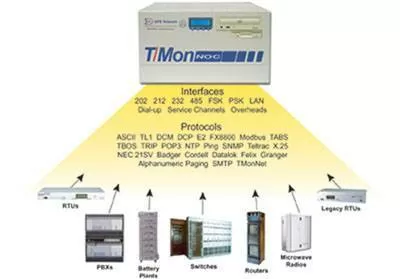
An advanced Modbus master can be used for more than simply communicating with Modbus slave devices. When seeking a master for your Modbus network and other devices, you should look for a master than can bring your Modbus alarms and notifications from your other protocol devices into one master screen. This will help you monitor your network as efficiently as possible, eliminating the need for multiple operators and workstations to accomplish your network alarm monitoring.
The T/Mon NOC is one such Modbus master that can greatly increase your organization's visibility while reducing your monitoring costs. With an ordinary Modbus master, you will be unable to collect alarms from your non-Modbus devices. This will require you to deploy multiple masters to support all of the different protocols within your network, and hire additional operators to monitor the communications from these assorted masters.
With T/Mon NOC, you can have Modbus alarms and alarms from over twenty-five additional protocols forwarded into one master browser. This convenient, single-window view allows you to monitor your entire network of devices through a single workstation, using a single operator.
Another advanced feature of the T/Mon NOC Modbus master is the page and email alarm notifications utilized by the system. Anytime an alarm occurs within your network, your Modbus master will send a page or email directly to your network technician. These pages can even be directed to specific technicians according to your technical staff's schedule, and their individual skill sets. With these advanced features, you'll be the first to know anytime a slave device has lost communication with your Modbus master.
Related Products:
T/Mon NOC
Related Topics
Modbus HMI