Download our free DNP3 tutorial.
An introduction to DNP3 from your own perspective.
1-800-693-0351
Have a specific question? Ask our team of expert engineers and get a specific answer!
Sign up for the next DPS Factory Training!
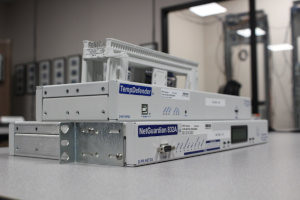
Whether you're new to our equipment or you've used it for years, DPS factory training is the best way to get more from your monitoring.
Reserve Your Seat TodayA DNP3 IED (Intelligent Electronic Device) is a microprocessor based controller within a SCADA system that collects data from sensors and power equipment, and communicates with an RTU (Remote Terminal Unit), DNP3 Master, or other equipment using the Distributed Network Protocol (DNP3). IEDs are most commonly seen in power utilities, but they are also used in water, waste, and other industries that require automation.
The role of an IED is to collect information and issue control commands within SCADA systems. These DNP3 commands are programmed reactions to certain changes in values like voltage or current. An IED can fall into a number of equipment categories. Some of these devices are protective relaying devices or load tap changer controllers. Other DNP3 IEDs are used as capacitor bank switches or recloser controllers.

Example of an IED Relay
For example, if a meter is above or below a desired threshold, the IED will activate a control function. The control function engages what it needs to to correct the problem and return the value to the normal range. This includes activities such as raising voltage levels or tripping circuit breakers.
In the early days of DNP IEDs, an IED could only perform a single control function. Today, microprocessors in IEDs allow them to issue multiple different control commands based on the data they collect.
Your IEDs serve a number of important roles in your SCADA system, so it's imperative you know that they're operating properly. If you're responsible for an unmanned site that uses DNP3 gear, how confident are you that your system is correctly provisioned? You'll know it is when you monitor your SCADA system components with a network alarm monitoring system.
A network alarm monitoring system is made up of a master, one or many RTUs, and SCADA system components, such as a DNP3 IED. RTUs are able to collect alarms from the system's components, or collect data to process into an alarm, and then forward these alarms to a DNP3 Master Station.
The master station then displays the alarm in its user interface. At the same time, it sends out notifications to network technicians. If a DNP3 IED loses connectivity, your technicians will be immediately alerted by the alarm.
Finding an advanced DNP3 master station to perform these functions is of critical importance to your SCADA network.
DPS' T/Mon LNX is a master for multiple protocols, including DNP3. It will provide you with the visibility of your DNP3 IEDs. At the same time, it will bring in alarms from your entire SCADA network, even ones using protocols other than DNP3 like Modbus or SNMP. What's more, the T/Mon LNX can northbound any alarm it receives to a master of your choice, provided you needed mediation beteween DNP3 and your master's supported protocol.
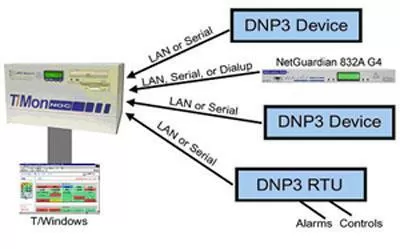
T/Mon LNX: A SCADA Master of Masters
With T/Mon, you'll be able to view all of your DNP3 IED alarms from your SCADA operation. On the same screen, you can view alarms from your other equipment. They'll be brought into a single master window, eliminating the need to deploy a separate monitoring master for the rest of your SCADA system.
DPS masters and RTUs provide instant alarm notifications. Your technicians will be informed of all the issues that arise. It doesn't matter whether they're from DNP3 IEDs or other devices. This will eliminate tedious analysis of your SCADA system and costly truck rolls to a remote site, while greatly increasing repair times and network reliability.
Your IEDs control important functions within your network. You can't afford to leave them unmonitored. You need the most proven technology to maintain the reliability of your mission-critical processes. Gain the reliability you need with a T/Mon LNX.