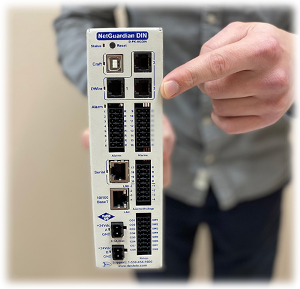
Download our free Monitoring Fundamentals Tutorial.
An introduction to Monitoring Fundamentals strictly from the perspective of telecom network alarm management.
1-800-693-0351
Have a specific question? Ask our team of expert engineers and get a specific answer!
Sign up for the next DPS Factory Training!
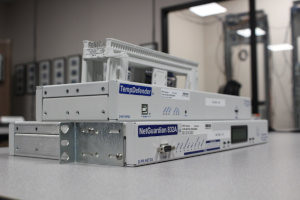
Whether you're new to our equipment or you've used it for years, DPS factory training is the best way to get more from your monitoring.
Reserve Your Seat TodayHow an international long-distance carrier consolidated mixed-protocol network alarms into a single NOC view.
| Field | Detail |
|---|---|
| Industry | International Telecommunications |
| Company Type | Long-distance carrier and ISP |
| Geography / Coverage | Multiple sites across the US and Canada |
| Primary Challenge | Monitoring mixed ASCII/TL1 alarms across diverse gear |
| Solution Deployed | T/Mon master station + NetGuardian RTUs |
| Key Result | Unified alarm visibility across all network equipment |
| Products Used | T/Mon, NetGuardian 216T, NetGuardian 832A |
Founded in 1989, Startec Global Communications provides telephone, internet, and communications services to ethnic businesses and consumers across the United States. The company also works with international long-distance carriers and ISPs serving the world's emerging economies, operating sites across the US and into Canada.
Startec's network includes a Sonus softswitch, GSP switch, DACS units, and fiber muxes, all generating alarms via ASCII text and TL1 protocol. Relying on operators to watch those text streams was unreliable and wasteful - any significant traffic volume makes it easy to miss critical alarms. They also needed environmental monitoring at several sites, which their existing gear didn't support.
"We have a softswitch, a GSP switch, DACSes and Fiber muxes. We're running both TDM & VoIP for the domestic and international calls that we're terminating." - Walid Karim, NOC Manager, Startec Global Communications
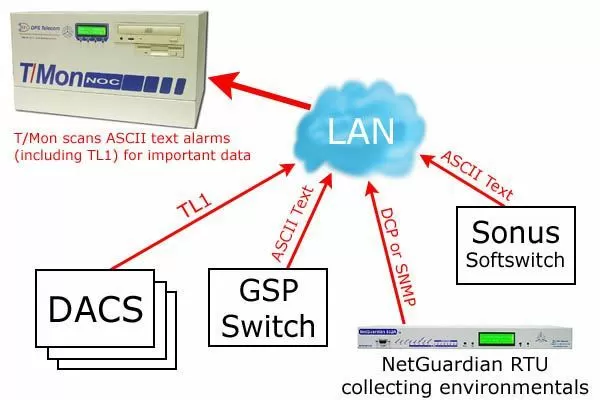
After evaluating their options, Startec selected a T/Mon master station to collect alarms from their Sonus softswitch, GSP switch, DACS, and TDAX gear. T/Mon handles both ASCII text and TL1 protocol natively, replacing manual alarm watching with automated, centralized collection. For environmental monitoring, they added NetGuardian RTUs that report back to the T/Mon master.
The T/Mon master manages alarms from all of Startec's switching gear via ASCII text and TL1 protocol. NetGuardians report environmental data back to T/Mon via DCP, but can alternatively report via SNMP to any standard SNMP manager.
With T/Mon in place, Startec's NOC has a single point of visibility for alarms across every part of the network - GSP switch, softswitch, DACS, and fiber muxes alike. Technicians no longer need to watch ASCII text streams manually. Any circuit outage or equipment alarm surfaces immediately, regardless of which gear type generated it.
| Outcome | Detail |
|---|---|
| Alarm Sources Consolidated | Softswitch, GSP, DACS, and fiber muxes in one system |
| Environmental Monitoring | Temperature and humidity tracked at multiple sites |
| Protocol Coverage | ASCII text and TL1 alarms collected natively |
"Any time circuits go down, we'll see those alarms. Whether they are GSP alarms, Soft switch alarms DACS or Fiber mux alarms." - Walid Karim, NOC Manager, Startec Global Communications
| Takeaway | Detail |
|---|---|
| Multi-Protocol Support | T/Mon collects ASCII and TL1 alarms from mixed gear without custom integration work. |
| Environmental Monitoring | NetGuardian RTUs fill monitoring gaps that existing network equipment can't address. |
| Unified NOC Visibility | All alarm types - switching, softswitch, and environmental - are managed from one platform. |
| Product | Description |
|---|---|
| T/Mon Master Station | Multiprotocol alarm master with native ASCII, TL1, and SNMP support. |
| NetGuardian 216 G3 | Remote telemetry unit for environmental and alarm monitoring at remote sites. |
| NetGuardian 832A | High-capacity RTU for collecting and reporting alarms from remote network equipment. |
Yes. T/Mon natively supports TL1, which is an ASCII text-based protocol used by DACS, digital switches, and other telecom gear. It collects these alarms alongside SNMP and other protocol outputs, so your NOC gets a unified view without requiring operators to manually monitor separate text streams. This is exactly the setup Startec deployed across their US and Canada sites.
NetGuardian RTUs monitor conditions like temperature and humidity at remote sites, then report back to a central T/Mon master station via DCP. They can also report via SNMP to any third-party SNMP manager, which gives you flexibility if your organization already has an existing management platform in place.
T/Mon supports 30+ protocols, so it can collect alarms from a wide range of telecom gear - including softswitches, GSP switches, DACS, fiber muxes, and legacy TDM equipment. If your gear outputs alarms via SNMP, ASCII text, TL1, DNP3, Modbus, or other common protocols, T/Mon can handle it. DPS also develops support for new protocols when a customer's requirements call for it.
Whether you're running a mixed TDM/VoIP network or trying to unify alarms from different gear types, DPS Telecom can help you find the right approach.