Check out our White Paper Series!
A complete library of helpful advice and survival guides for every aspect of system monitoring and control.
1-800-693-0351
Have a specific question? Ask our team of expert engineers and get a specific answer!
Sign up for the next DPS Factory Training!
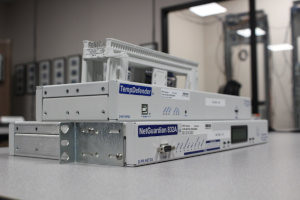
Whether you're new to our equipment or you've used it for years, DPS factory training is the best way to get more from your monitoring.
Reserve Your Seat Today
Central Lincoln PUD operates an electric utility communications network spanning a large coastal territory. To strengthen alarm visibility across remote sites and support informed dispatching during outages, the utility deployed DPS Telecom NetGuardian remote telemetry and alarming.
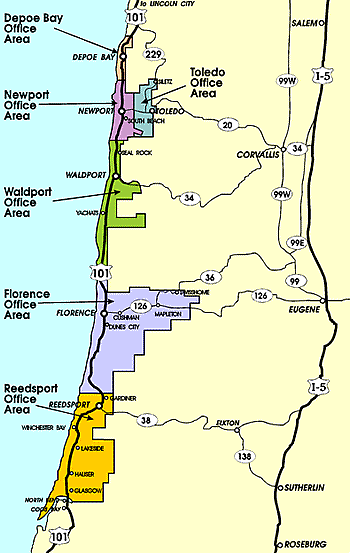
Central Lincoln PUD is a public-owned electric utility and has been serving its customers since 1943. Central Lincoln has well over 32,000 residential and commercial customers, with coverage extending 120 miles along the Oregon coastline and servicing an area of about 700 square miles.
In order to manage such a long and wide area, Central Lincoln has created and actively maintains its own communications network. Fiber is run across the Oregon coastline and is the backbone of Central Lincoln's SCADA (Supervisory Control And Data Acquisition) system.
This fiber is the primary communications channel between the substations and offices, providing data and phone. Technicians and dispatch are able to communicate and function effectively during power outages. Due to the critical nature of these operations, network alarm monitoring plays a vital role in Central Lincoln's overall strategy to maintain service.
| Industry | Electric utility |
|---|---|
| Company Type | Public-owned electric utility |
| Geography/Coverage | Oregon coastline - approximately 120 miles; about 700 square miles; well over 32,000 customers |
| Primary Challenge | Maintain network alarm visibility for remote substations and communications infrastructure while upgrading from legacy/serial devices to IP/Ethernet |
| Solution Deployed | NetGuardian remote alarm collection and notification with web-based status visibility |
| Key Result | Improved visibility to speed initial troubleshooting and enable more accurate dispatch decisions |
| Products Used | NetGuardian 832A |
Central Lincoln PUD supports power operations with a self-maintained communications network that ties substations and offices together. Fiber connectivity along the coast provides the backbone for SCADA data exchange and day-to-day coordination between technicians and dispatch.
Because communications availability directly affects outage response and operational coordination, Central Lincoln treats alarms and status visibility as essential operational inputs, not optional IT signals.
Central Lincoln faces several monitoring challenges. From traditional network diversity issues, like having older equipment while phasing in newer gear, as well as other concerns like the weather, substation surveillance, and windshield time. Central Lincoln has steadily improved its network, giving its technicians even more event visibility across the Oregon coastline. When new electricity transmission lines go up, Central Lincoln proactively extends its fiber between the new areas and the substations.
Because most of the transmission lines are overhead, one of Central Lincoln's key priorities is to provide redundancy to the areas it serves. By adding loop feeds in certain areas, Central Lincoln is able to reroute power during outages.
"Part of the rebuilding, is trying to add loop feeds so if the power does go down, there is an alternate path"
- Dennis Woodward, Communications Foreman, Central Lincoln PUD
For an electric utility operating across a large geography, long travel times can slow restoration if dispatch does not have clear, actionable information. Central Lincoln needed the ability to see what was happening at remote sites quickly enough to decide where to send crews and what equipment to bring.
With the visibility of the NetGuardian, Central Lincoln can easily keep an eye on their remote sites. When alarms do happen, the extra visibility helps the initial troubleshooting. Dispatch can then make accurate and informed decisions, sending technicians out to the correct site and well prepared with the right tools.
Using email, Dennis is able to log in and check the alarm status sent from the unit. The NetGuardian is capable of emailing, sending text messages, and paging technicians as alarms are detected. With the added feature of the web browser interface, dispatch and technicians can log in and get more detail about the problem, monitor conditions at the site, and remotely operate the equipment.
In practical terms, DPS Telecom NetGuardian RTUs are designed to bring many types of site signals into one place - including discrete alarms (dry contacts), analog readings (such as environmental or power measurements), and network information via SNMP. That approach helps utilities standardize alarming and reporting across mixed equipment generations and mixed protocols, which is common in geographically distributed substations and communications huts.
Central Lincoln uses NetGuardians as standalone remotes for alarm collection and notification. That standalone approach allows each remote location to continue reporting alarms even when there is no centralized monitoring software connected, while still giving dispatch and technicians fast access to the current status through notifications and the web interface.
At the same time, Central Lincoln is well positioned to centralize monitoring as needs evolve. An alarm monitoring system like the T/Mon SLIM or other SNMP managers can fit into the network and provide centralized visibility of NetGuardian alarms across multiple remote sites.
When a utility moves from standalone alarming to centralized alarm management, the goal is typically consistent: reduce time-to-awareness and time-to-triage. DPS Telecom's T/Mon alarm management solutions are built to aggregate alarms from NetGuardian RTUs and other sources into one view so operators can correlate events, assign response, and maintain situational awareness across many sites.
With training courses like the DPS Telecom Factory Training, Central Lincoln is succeeding in keeping up-to-date with changing Network Alarm Monitoring technologies.
"Everything is going to Ethernet, even the meters at the substations are Ethernet, IP is becoming the transport of default, the older alarm monitoring systems we have don't support IP transport"
- Dennis Woodward, Communications Foreman, Central Lincoln PUD
Dennis highlighted a key factor in selecting the NetGuardian:
"One of the things that sold me on the NetGuardian 832A is that you could take it from serial to an IP transport."
- Dennis Woodward, Communications Foreman, Central Lincoln PUD
The NetGuardian fits right in. It allows Central Lincoln to steadily upgrade their older remote telemetry units over time as their budget and manpower permits.
"The NetGuardian still has the tie back to the older way of doing things, so with our other equipment we could connect straight into it without having to switch it out,"
- Dennis Woodward, Communications Foreman, Central Lincoln PUD
In many utility environments, this kind of protocol and interface flexibility is what makes a monitoring rollout practical: teams can add IP-based alarming where it helps most, while maintaining interoperability with legacy devices until planned replacement cycles catch up.
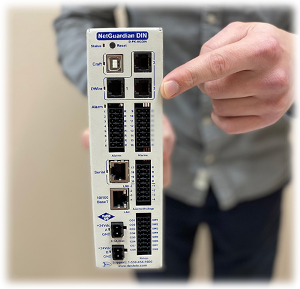
NetGuardian 832A - Remote alarm collection, notification (email/SMS/paging), and web-based status visibility for utility sites
If you are designing for centralized visibility, consider DPS Telecom alarm management solutions that can aggregate NetGuardian alarms into a single operator view, such as T/Mon LNX. Centralized monitoring is especially valuable when you have many remote sites, mixed-vintage equipment, or an evolving IP transport strategy.
Utility communications links support SCADA telemetry, dispatch coordination, and outage operations. Timely alarms help teams identify trouble quickly and reduce time spent diagnosing issues in the field.
A NetGuardian can collect discrete alarms and analog measurements and can also monitor networked devices using SNMP. It then notifies personnel and provides local web-based visibility so teams can triage issues before rolling trucks.
As more devices and meters use Ethernet/IP, legacy alarm gear that cannot communicate over IP becomes harder to integrate. Choosing an RTU that supports modernization while maintaining legacy connections simplifies the transition.
Protocol mediation bridges older interfaces and protocols to modern IP/SNMP monitoring so you can keep existing devices in service while increasing visibility. This is often part of an upgrade path where replacement is phased over time.
Centralized alarm management is typically valuable when multiple sites must be monitored consistently, when alarm correlation improves response, or when operators need a single view across many NetGuardian RTUs and other network elements.
Many clients have a significant investment in their existing equipment, but need to improve visibility throughout their network. Using protocol mediation solutions can bridge the gap between older devices and modern IP monitoring while enhancing and maintaining your current level of visibility.
Learn more about alarm monitoring with T/Mon LNX, T/Mon SLIM and NetGuardian RTUs.
To receive a price quote or ROI analysis, call 1-800-693-0351
Get a Free Consultation - or call DPS Telecom at 1-800-693-0351 to speak with an expert about your utility alarm monitoring, SCADA visibility, or modernization project.