Check out our White Paper Series!
A complete library of helpful advice and survival guides for every aspect of system monitoring and control.
1-800-693-0351
Have a specific question? Ask our team of expert engineers and get a specific answer!
Sign up for the next DPS Factory Training!
Whether you're new to our equipment or you've used it for years, DPS factory training is the best way to get more from your monitoring.
Reserve Your Seat TodayA distributed control system (DCS) is a broad term referring to a process in which the controlling elements are distributed throughout, rather than controlled centrally. In more general terms, a DCS is a process that requires separate computers at each step of the process.
It's the sort of control system you'd see in processes that require a separate system of logic for each individual step, such as municipal electric bus systems or oil refining flow and pressure control. Really, DCS is advantageous in any project with a large number of variables that you want to automate in a distributed topolgy.
This differs from Programmable Logic Controller systems, in which process control is typically handled centrally. PLC systems work very well for less-variable processes, where each step can be timed or expected to behave in a specific manner.
They two aren't necessarily at odds, however. Programmable logic controllers can be used quite well for specific DCS processes.
While distributed controls are handy for highly variable processes, they can present serious problems if a single controller goes down. In a PLC, if the controller goes down, the process follows. In a DCS, if a single controller goes down, the rest of the controls don't necessarily stop, which can result in ruined batches or damage to the system.
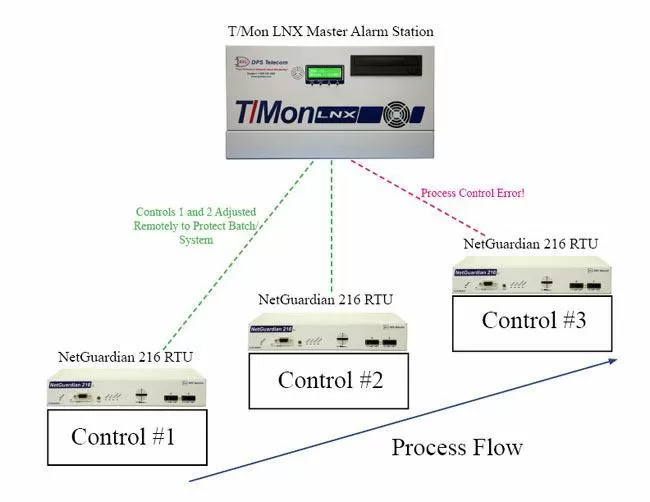
Therefore it's critical to your DCS-based processes to have a reliable monitoring system so your technicians can take action the instant they recognize a problem. You should distribute a series of remote telemetry units like the NetGuardian series throughout the system to notify technicians if anything goes awry. These RTUs can report not only on the status of the distributed controls, but the communications network, and any external variables (temperature, humidity, etc.) that might have an effect on your system, keeping you in the loop.
Working with an alarm master station like T/Mon can also provide you with comprehensive network visibility. The master station management system will bring in alarms for the entire monitoring system and provide a map-based graphical interface for your DCS, so your technicians can know what's wrong and where to go to fix it.
For more information about DPS Telecom's Remote Telemetry Solutions, see:
Monitoring your remote sites - more information...
Download PDF: Remote Site Monitoring Tutorial